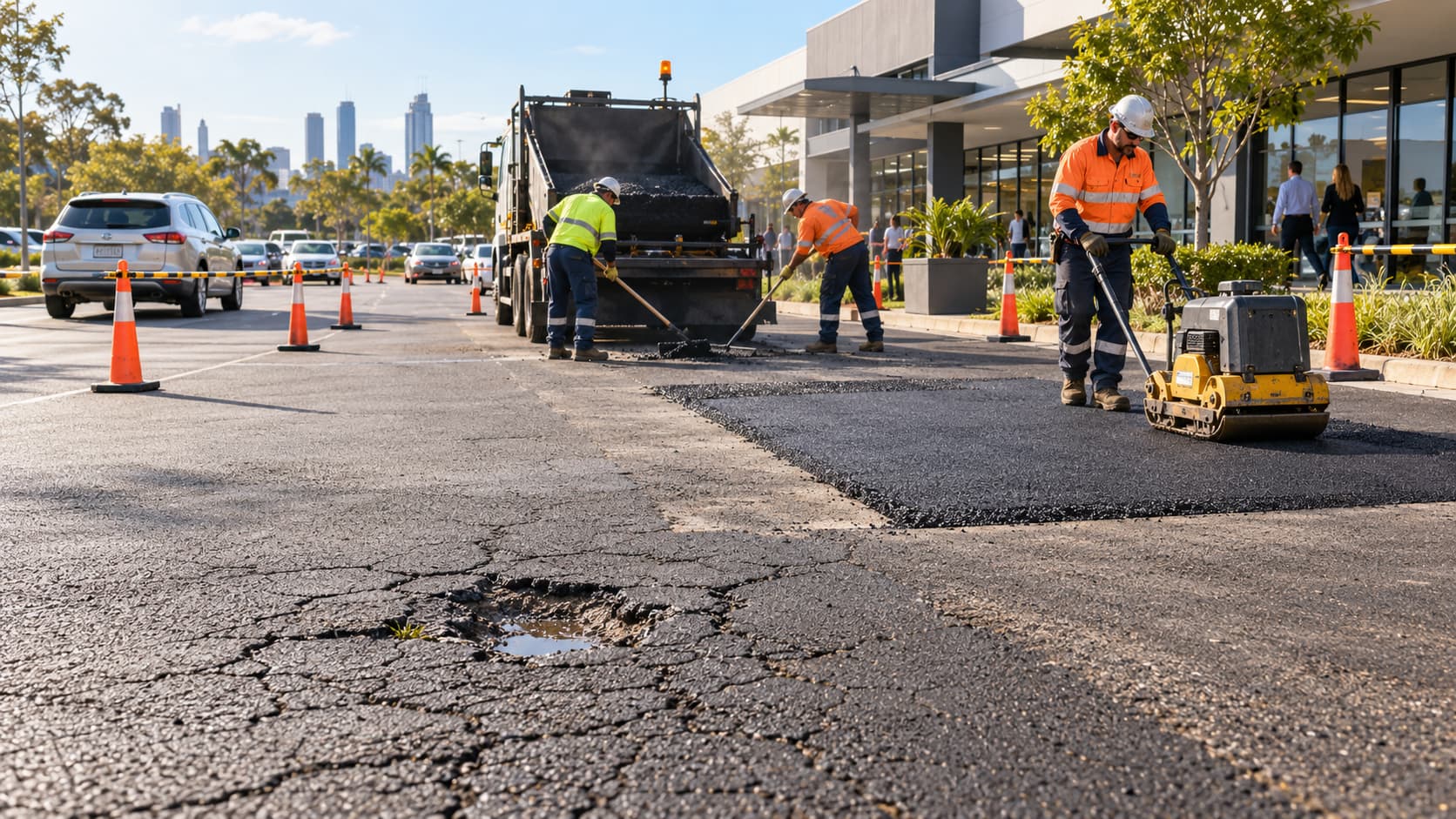
The right asphalt car park repair depends on what has failed. A few isolated potholes may only need localised patching. Widespread cracking, loose aggregate or a worn surface may justify resurfacing. Deep movement, repeated failures or extensive base damage can make reconstruction the more reliable option.
The important point is not to choose a treatment from appearance alone. A repair should address the cause of the damage, keep vehicles and pedestrians safe, and suit the way the property needs to operate during the work.
Why car park damage should be assessed early
Small defects rarely improve on their own. Water enters cracks, traffic works the edges loose and a shallow depression can hold more water after every storm. In a commercial car park, the consequences extend beyond appearance.
Damage can affect:
- vehicle and pedestrian safety
- access to shops, offices or industrial premises
- trolley, pram and mobility-aid movement
- drainage across the paved area
- the professional presentation of the property
- future repair costs if water reaches the pavement base
A prompt inspection can help separate a surface defect from a deeper pavement problem before the damaged area grows.
Start by identifying the type of failure
Isolated potholes
A pothole usually forms after the surface and supporting material have weakened. Water, repeated wheel loads and failed edges can all contribute.
Simply filling the visible hole without removing unstable material may deliver only a short-term result. A proper assessment should check the depth of the failure, the condition around it and whether water is entering from nearby cracks or low points.
Cracking
Not all cracks mean the same thing. A single narrow crack may be a local movement joint or an early surface defect. A network of interconnected cracks can suggest that the pavement is flexing or the support below is deteriorating.
The pattern, width and movement matter. Treating every crack with the same product is not a substitute for diagnosing why it appeared.
Depressions and wheel ruts
Low areas can form where the base has compacted unevenly or where repeated heavy vehicles follow the same path. Depressions may hold water, while ruts can affect steering and create an uneven surface for pedestrians.
If the underlying material is unstable, placing a thin layer over the top may reproduce the same shape later.
Ravelling and loose stone
Ravelling occurs when aggregate begins to loosen from the asphalt surface. It can start as a rough texture and gradually develop into shallow holes or worn traffic lanes.
The extent of the deterioration helps determine whether a local treatment is realistic or whether the broader surface is approaching the end of its useful condition.
Edge failure
Car park edges are vulnerable when vehicles regularly track outside the pavement, water washes material away or the edge lacks support. Repairing the asphalt without restoring support at the edge can allow the failure to return.
Option 1: localised asphalt patching
Patching is usually most appropriate when damage is limited to a small number of clearly defined areas and the surrounding pavement remains sound.
A lasting patch normally involves more than placing material into a hole. The unstable section may need to be cut or removed, the exposed base checked and repaired where necessary, and the new asphalt compacted against clean, sound edges.
Patching can suit:
- isolated potholes
- local utility cuts
- small failed areas around entries or loading points
- damage caused by a specific, corrected issue
The advantage is that most of the car park stays untouched. The limitation is that repeated patches across a generally worn surface can become inefficient and visually inconsistent.
Option 2: resurfacing or an asphalt overlay
Resurfacing places a new asphalt layer over a prepared existing pavement. It can restore a smoother, more consistent surface without removing the entire structure.
It may be appropriate when:
- deterioration is widespread but the underlying pavement is generally stable
- the surface is oxidised, rough or lightly cracked
- numerous small repairs would cover a large proportion of the car park
- levels allow an overlay without creating problems at doors, kerbs or drains
Preparation remains critical. Failed areas should be repaired before the overlay, and existing cracks or level issues need to be considered. New asphalt will follow the shape beneath it, so an overlay should not be used to hide active structural movement.
Resurfacing also changes surface levels. Thresholds, drainage points, accessible paths and adjoining pavement need to be checked before work begins.
Option 3: partial or full reconstruction
Reconstruction removes failed pavement and rebuilds the supporting layers before new asphalt is placed. It is the most involved option, but it can be the right one when the base is no longer reliable.
Signs that deeper work may be needed include:
- broad areas of interconnected cracking
- repeated potholes in the same locations
- extensive depressions or pumping under traffic
- obvious movement at pavement edges
- poor levels that continually trap water
- damage caused by vehicle loads beyond the original design
Not every defect requires full reconstruction. In many car parks, only the failed section needs to be rebuilt while sound areas are retained. The goal is to match the scope to the actual condition rather than automatically choosing the largest job.
Repair, resurface or replace: a practical comparison
| Condition | Likely starting point | Important qualification |
|---|---|---|
| One or two isolated potholes | Localised patching | Check the base and water entry |
| Several repairs but sound pavement between them | Targeted patching or partial resurfacing | Compare the repaired area with the total car park |
| Widespread surface wear or light cracking | Resurfacing assessment | Existing levels and structural stability must suit an overlay |
| Deep rutting, movement or repeated failures | Partial or full reconstruction assessment | The supporting pavement may need rebuilding |
| Ongoing ponding | Investigate levels and drainage first | A surface-only repair may not solve the cause |
This table is a guide, not a diagnosis. The pavement needs to be inspected before a scope is confirmed.
Traffic type changes the repair decision
A small office car park and an industrial yard may look similar on a plan but carry very different loads.
The assessment should consider:
- normal daily vehicle numbers
- delivery vans and waste trucks
- turning areas where tyres place extra stress on the surface
- loading zones and bin collection points
- vehicles that remain parked for long periods
- whether the original pavement was designed for current use
Heavy vehicles can expose weak bases and unsupported edges more quickly. If the way the property is used has changed, the repair should be planned for the current traffic rather than simply recreating the old surface.
Water is often part of the problem
Queensland rain can turn a small pavement defect into a larger failure. Water enters through cracks, sits in depressions and can weaken unbound material below the asphalt.
Before approving repairs, look for:
- ponding after rain
- blocked or damaged drainage points
- runoff entering from adjoining properties or roofs
- low edges where water leaves the pavement
- cracks that reopen along a wet area
RTB Civil can assess how surface levels affect the asphalt scope. If separate hydraulic drainage or structural design is required, that should be identified and coordinated with the appropriate specialist rather than hidden inside a paving quote.
Plan repairs around customers and operations
Commercial paving work has to account for people, deliveries and business access.
A practical staging plan may address:
- which entry remains open
- temporary vehicle and pedestrian routes
- access for emergency and service vehicles
- delivery and waste-collection times
- noisy work periods
- curing or reopening requirements for the selected material
- communication with tenants and customers
Some projects can be completed in sections so part of the car park remains available. Others are safer and more efficient with a planned closure. The right approach depends on the layout, repair area, equipment access and time needed before traffic can return.
Avoid promising an exact reopening time before the contractor confirms the material, weather and site conditions.
What affects the repair quote?
The visible area is only one factor. A car park repair quote may change with:
- number and depth of failed areas
- condition of the underlying base
- asphalt quantity and specification
- access for machinery and trucks
- traffic control and staging
- removal and disposal of damaged material
- levels around kerbs, entries and drainage points
- working hours and site restrictions
- reinstatement items included in the scope
Ask for a written scope that distinguishes patching, base repairs, resurfacing and exclusions. If line marking, drainage changes or other associated work is needed, confirm whether it is included, coordinated separately or excluded.
Preventive maintenance after repairs
Once the immediate defects are addressed, simple inspections can slow the next round of deterioration.
Property managers can:
- inspect the surface after heavy rain
- act on new cracks before edges break away
- keep drainage paths clear
- remove oil or chemical spills promptly
- prevent landscaping or stored materials from blocking runoff
- watch loading and bin areas for early rutting
- record recurring defects in the same location
A recurring patch failure is useful information. It suggests that the cause may sit below or beside the surface rather than in the asphalt patch itself.
Questions to ask before approving a car park repair
- What caused the damage?
- Is the failure limited to the asphalt or does it extend into the base?
- Why is patching, resurfacing or reconstruction recommended?
- How will existing levels and drainage points be protected?
- Can the work be staged around business operations?
- When can different vehicle types return?
- What preparation and compaction are included?
- Which associated works are excluded?
- How should the repaired area be maintained?
- What signs should trigger another inspection?
Frequently asked questions
Can an asphalt car park be repaired without replacing everything?
Yes. Localised patching or partial reconstruction may be suitable where damage is limited and the surrounding pavement remains stable. An inspection is needed to confirm whether the base is sound.
When is resurfacing better than patching?
Resurfacing may offer better value when wear or light cracking affects a broad area and many separate patches would be required. The existing pavement must still provide suitable support and levels for an overlay.
Can you resurface over potholes?
Failed areas should be repaired and prepared first. Covering unstable material may allow the pothole or depression to return through the new surface.
How long will car park repairs disrupt the property?
Timing depends on the repair method, area, access, weather and traffic requirements. A contractor should confirm the staging and reopening plan after inspecting the site.
Does the car park need to be empty?
Often the work area needs to be clear, but some larger sites can be completed in stages. Safe access for machinery, customers and emergency vehicles determines what is practical.
Get a clear repair scope before the damage spreads
RTB Civil provides asphalt car park construction, repair and resurfacing across Brisbane and South East Queensland. Our locally operated team brings more than a decade of asphalt and bitumen experience, with practical advice based on the condition and use of the site.
Review our asphalt car park services or request a free quote. You can also call 0423 783 556 to discuss the property and arrange an inspection.