A good asphalt driveway is one of the cheapest hard surfaces you can put on a Queensland property. It is not set-and-forget, though. Summer heat, sudden downpours, tree roots, and the daily weight of cars all wear it down over time. Leave it alone and a small crack becomes a pothole, and a pothole becomes a resurfacing job.
Most asphalt driveway repair jobs are straightforward, and the sooner you deal with them, the less they cost. This guide runs through the problems we see most often on home and commercial driveways, how each one gets fixed, and how to tell whether you need a quick patch, a resurface, or a full replacement.
Signs your asphalt driveway needs repair
Asphalt rarely fails overnight. It warns you first. Watch for:
- Cracks of any kind, especially ones that are widening or letting water in
- Potholes, or soft sunken patches that hold water after rain
- A faded, grey, brittle surface where the binder has dried out
- Loose stones coming away underfoot
- Water that pools and does not drain within an hour or two
- Edges breaking away where the asphalt meets lawn or garden beds
Catch these early and the repair is usually simple. Ignore them and water becomes the problem. Once it works under the surface and into the base, the damage speeds up fast.
Common asphalt driveway problems (and how they are fixed)
1. Cracking
Cracks are the most common issue, and they come in a few forms. Hairline and linear cracks sit on the surface and usually come from age, temperature swings, or minor ground movement. Alligator cracking, the web of interlinked cracks that looks like reptile skin, is the one to worry about, because it means the base underneath is starting to fail.
The fix: single cracks get cleaned out and filled with a flexible sealant so water cannot get in. Alligator cracking is a different story. You cannot just fill it, because the foundation is the real problem, so that section usually has to be cut out, rebuilt, and resurfaced.
2. Potholes
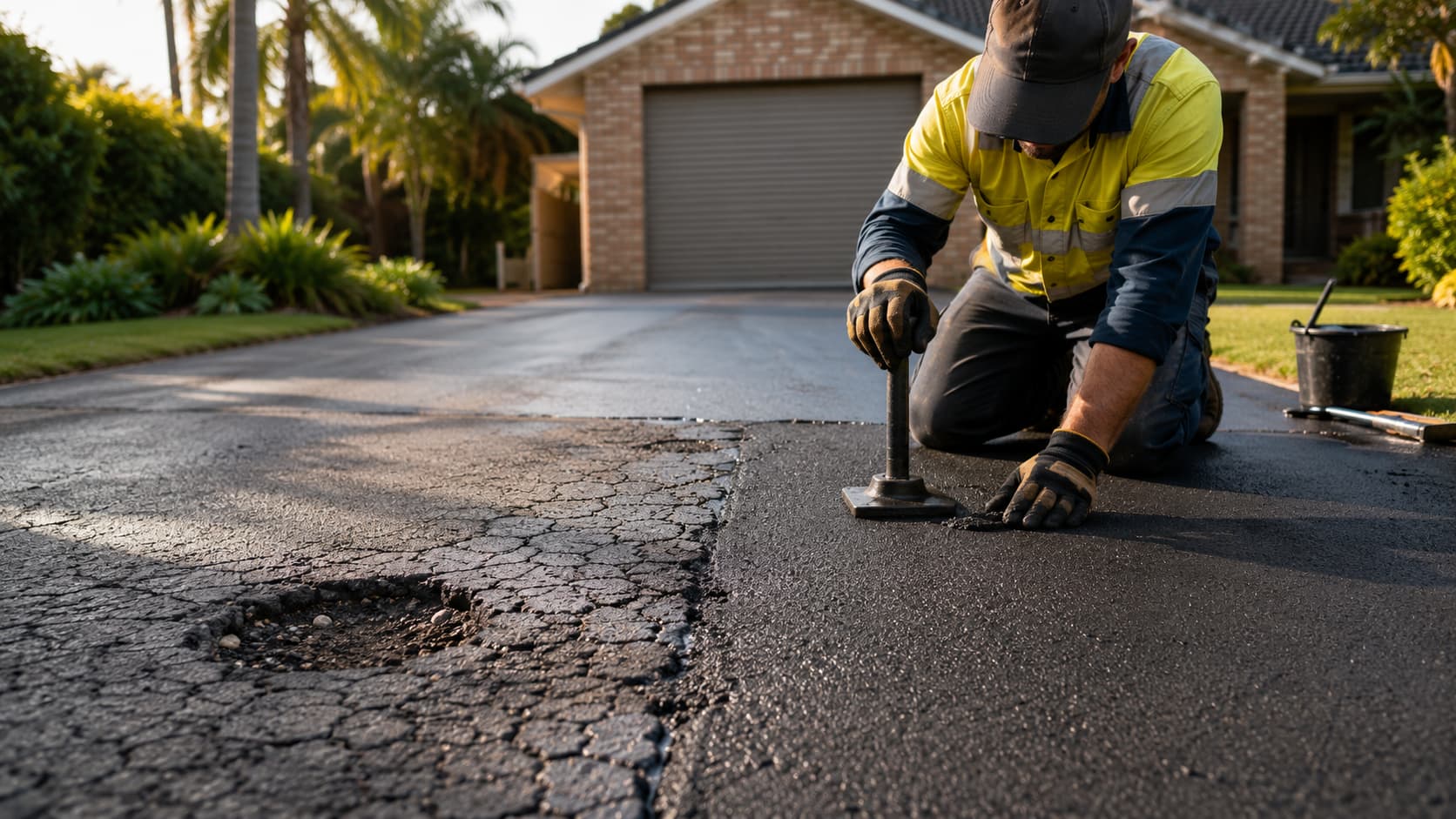
Potholes start when water gets through the surface, weakens the base, and traffic breaks the unsupported asphalt away. They are a hazard for people and cars alike, and they grow quickly once they appear.
The fix: the damaged area is cut back to a clean, square edge, any failed base material is dug out and re-compacted, then fresh hot-mix asphalt is laid and rolled flush with the surface around it. Done properly, the patch bonds to the existing asphalt and is hard to spot afterwards.
3. Ravelling and loose aggregate
Ravelling is when the surface starts shedding its stones because the bitumen binder has broken down, usually from age or UV. You will see loose grit and feel a rougher surface underfoot.
The fix: light ravelling can be handled with a surface treatment or seal coat. If it is widespread, the driveway usually needs resurfacing with a new wearing course.
4. Depressions and birdbaths
These are low spots that collect water, normally caused by poor compaction when the driveway was first laid, or by the base settling over the years.
The fix: shallow dips can be filled and levelled. Deeper ones often need the base sorted out first, because if you do not address the cause, the dip just comes back.
5. Edge breaks and crumbling borders
Asphalt is strongest when something supports it on every side. Edges left unsupported, especially next to lawn or garden beds, crack and crumble under the weight of a car.
The fix: broken edges are cut back and re-laid, and an edge restraint or concrete haunch stops it happening again.
6. Oxidation and fading
That deep black surface fades to a dull grey as the binder oxidises in the sun. The fading itself is only cosmetic, but it is also an early sign the surface is drying out and turning brittle.
The fix: a seal coat brings the colour back, adds a protective layer, and buys the surface more time. This one is maintenance more than repair.
Repair, resurface, or replace?
One of the questions we get most is whether a driveway needs a small repair or something bigger. Here is a simple way to think about it.
| Option | Best for | What is involved |
|---|---|---|
| Patch or crack repair | Isolated cracks, a few potholes, small damaged areas | A targeted fix to the affected spots only |
| Resurfacing (overlay) | A sound base with a worn, cracked, or faded surface | A new layer of asphalt laid over the existing one |
| Full replacement | Widespread alligator cracking, base failure, major drainage issues | Removing the old surface and base, then rebuilding from the ground up |
It almost always comes down to the base. If the foundation is sound, you can usually repair or resurface. If the base has gone, patching the top is a short-term fix at best, and your money goes further on a proper rebuild.
DIY versus professional repair
The cold-mix pothole bags from the hardware store have their place. If you have a hazard to make safe today, they will do the job for now. But they are a stop-gap. They do not bond like hot-mix asphalt, they rarely match the surface around them, and they do nothing for the base problem underneath.
If you want a repair that looks tidy and lasts, professional asphalt driveway repair with hot-mix asphalt and proper compaction is better value over the life of the driveway.
What affects the cost of asphalt driveway repair?
Every driveway is different, so the only way to get an accurate price is a site visit and a quote. That said, the things that move the cost most are:
- the size and depth of the damaged area
- the type of repair, since a crack fill is far cheaper than a base rebuild
- the condition of the base, and whether it needs correcting
- access for equipment, and how much material the job needs
- drainage work, if water turns out to be the root cause
For a rough sense of asphalt and bitumen pricing before you book a look, see our guides on how much a bitumen driveway costs and bitumen cost per square metre.
How to make repairs last
A few habits go a long way:
- fill cracks early, before water reaches the base
- keep water moving off the surface so it cannot pool
- reseal every few years to protect the binder from UV
- spread the load, and keep heavy vehicles off the same spot and off unsupported edges
- deal with a small crack now, because it is far cheaper than next year’s pothole
Not sure asphalt is the right surface to begin with? Our guides on what asphalt is and the difference between bitumen and asphalt explain how it works and why it copes well with the Queensland climate.
Frequently asked questions
- How long does an asphalt driveway last? With a good install and a bit of upkeep, such as sealing cracks and resealing now and then, an asphalt driveway can last a long time. What matters most is the quality of the original base, the drainage, and whether small damage gets fixed before it spreads.
- Can you repair a small section without redoing the whole driveway? Yes. Isolated cracks and potholes can be patched on their own, as long as the base around them is still sound. You only need a full resurface or replacement when the damage is widespread or the foundation has failed.
- Is it better to repair or resurface? It depends on how much of the surface is affected and what shape the base is in. A few isolated problems call for patching. A worn or cracked surface over a solid base is a good candidate for resurfacing. A failed base means replacement.
- How soon can I drive on a repaired driveway? It depends on the type of repair and the weather. Your contractor will give you a specific time, but as a rule, keep traffic off a fresh patch or overlay until it has fully cooled and set.
Cracks, potholes, or a tired-looking driveway? Road Tek Bitumen repairs and resurfaces asphalt driveways across Brisbane and Central Queensland. Get in touch for a free on-site inspection and quote.